Tuesday, March 31, 2009

Cognitive Development in Temple Going Children

The following is an abstract of a paper which deals with effect of going to temples on children. Really interesting

Temple Ecology and Cognitive Development: A Report from South India

R. Muralidharan
Department of Educational Psychology, National Council of Educational Research and Training, New Delhi, India

Ashok K. Srivastava
Department of Psychology, National Council of Educational Research and Training, New Delhi, India

The impact of growing up in the vicinity of Hindu temples on cognitive development was studied in the southern part of India. Enrolled in Grades 1 and 4, the participating children (N-281) were drawn from three kinds of ecology, i.e., families intimately associated with temple, families that are religious but not so intimately associated with temple, and families in non-temple areas, using a cross-sectional design. NCERT School Readiness Scale and Das-Naglieri Cognitive Assessment System were used to assess their cognitive development. Children associated with temples emerged to be more cognitively competent than other two groups of children on both points of schooling. Sex differences and their interaction with ecology were not significant for most of the measures. Results point to the role of temple institutions in shaping development of children byproviding rich and variegated ecology.

Saturday, March 28, 2009

Princeton University to hold “Hinduism in the 21st Century” week

A special week of events at Princeton will focus on Hinduism in 21st Century America. Princeton University’s Hindu Life Program and student group Princeton Hindu Satsangam are collaborating to host ten separate events packed into one week of celebration and awareness. The series of events - which range from lectures and discussions to performances and yoga demonstrations - will be held from Saturday, March 28, to Sunday April, 5.

The week explores the intersection of India’s ancient spiritual traditions with the modernity of American life. Organizers hope that the theme will not only resonate with members of Princeton’s Hindu community, but also serve as an impetus for those from the broader community to learn more about the faith.

“In presenting such a variety of programming, we wish to convey the diversity within Hinduism itself,” said Vineet Chander, Princeton’s Coordinator for Hindu Life and principal organizer of Hinduism in the 21st Century. “At the same time, we hope that each event will allow us to go deeper in exploring our theme, and gain insight into the faith as a fluid, living tradition faced with both challenges and opportunities in the modern world.”

Highlights of the week include a field trip to one of the first Hindu temples established in the United States, a panel discussion exploring the tensions between the academic and practitioner’s approaches to Hinduism, a coffee-house-style discussion about Hinduism’s take on the real-life struggles faced by American college students, and a student-driven arts festival. Hinduism in the 21st Century also pays homage to the popularity of yoga and spiritual vegetarianism - perhaps Hinduism’s biggest contributions to American pop-culture - with an interactive yoga class and a discussion of Hinduism and animal rights, held jointly with the Princeton Animal Welfare Society.

The week’s climax is a formal dinner, featuring a key-note address by Dr. Uma Mysorekar, president of the Hindu Temple Society of North America. Earlier this year, Dr. Mysorekar offered a Hindu benediction at President Obama’s inauguration–the first time in history that a Hindu prayer was offered at a presidential inauguration. Princeton’s Hindu Life program will also honor Dr. Mysorekar with its first annual Hindu-American Inspiration of the Year Award.

Source: HPI

Thursday, March 26, 2009

Hindu Temples - What Happened to them?

Hindu Temples - What Happened to Them Hindu Temples - What Happened to Them Smarth A detailed description of the controversy surrounding Hindu temples and their destruction by the Mughals. A long listing of each temple, its location and what happened to it.

Wednesday, March 25, 2009

Dollars poured into India for Conversion

Each year, the Government of India's Ministry of Home Affairs releases a report (URL below) entitled, "Receipt of Foreign Contributions by Voluntary Associations.

Following are the Associations which receive the funds

Gospel Fellowship Trust India, USA -- $60,305,263

Gospel for Asia, USA -- $36,100,000

Plan International, UK -- $29,257,895

Foundation Vicent E Ferrer, Alicante, Spain -- $27,428,947

Christian Aid, UK -- $21,094,737

Miseror Mozartstrasse, Germany -- $20,457,895

Foundacion Vicente Ferrer, Madrid, Spain -- $20,118,421

Oxfam, UK -- $19,721,053

NOVIB, Netherlands -- $19,321,053

Deptt for International Devpt (DFID), UK -- $15,723,684

Kindemothilfe, Germany -- $14,318,421

Save the Children Fund, UK -- $13,594,737

Manos Unidas, Spain -- $13,050,000

Missio, Germany -- $12,900,000

Population Service International USA -- $12,826,316

Total funds sent to India: -- $336,218,421

Though the Focus and goal as a ministry is to reach the 2.7 billion people who have never heard about the love of God (proselytisation intent, what else?)In India alone, there are over 500,000 villages. Most of the donations go toward relief work, rural development, medicine and education. "Maintenance of priests/preachers/other religious functionaries" is 15th on the list of purposes, receiving $21 million dollars of all foreign funding. Of the fifteen top donor agencies given eight are Christian, seven are secular and none are Hindu.

Following are the examples of intent given by these organizations themselves. Gospel Missions of India (GMI), “stays abreast of the work of the missionaries and ministries in India to ensure that gifts are faithfully invested for the Lord's work". Gospel for Asia is a Texas-based Christian missionary organization whose, "Focus and goal as a ministry is to reach the 2.7 billion people in the 10/40 window who have never heard about the love of God. In India alone, there are over 500,000 villages with no Gospel witness." These paragraphs are self explanatory about the real intent which is proselytisation through use of these funds. It is not service for the sake of service as the ground reality in Bharat shows.

The report is available on http://mha.gov.in/fcra/annual/ar2005-06.pdf

Source: haindavakeralam.com

Tuesday, March 24, 2009

Ramayana most popular art in Islamic Bangladesh

In the green hinterland of Islamic Bangladesh, the Ramayana is the most popular performing art form, says a leading playwright of the country. The Indian epic exists in harmony with Sufism and a variety of indigenous folk arts. “At least eight versions of the Ramayana, mostly folklore-based performances, are enacted in the countryside of Bangladesh. It is one of the most popular epics in the country, surpassing even the Mahabharata in its ratings,” Saymon Zakaria told IANS.

In Agra to attend the SAARC (South Asian Association for Regional Cooperation) Festival of Literature, Zakaria is an Islamic scholar who has written extensively about the Ramayana and the performances associated with it. “Ramayana in villages of Bangladesh is interpreted as a social comment exploring the model relationship between the husband, wife and the members of the family. References to Ramayana can often be found in local folklores that describe filial conduct codes and in domestic conservations,” Zakaria said.

Sita’s “Agni Pariksha” (test by fire), for example, was usually interpreted as the tribulations of the average Bangladeshi woman, who was subjected to tests both at her father’s home, in-laws’ house and in the conservative Islamic social mosaics of the villages that still frowned upon gender equality and freedom, explained the playwright.

The theatrical performance of “Ram Mangal”, the rural folk art form of Kishorganj, flourishes throughout the “bhakti” belt of Mymensingh district. “Ram Mangal is an invocation of Lord Rama, an incarnation of Vishnu, performed in the Bhakti (prayer songs) tradition,” Zakaria said. “Kushan Gaan”, the story of king Rama’s life, as narrated by his sons Luv and Kush, is enacted in villages of Korigram. “The script, full of music and dance, is a blend of the two versions of the epic written by seers Valmiki and Krittivas,” Zakaria explained.

Bangladesh also pays its tribute to Sita, the princess of Mithila and the queen of Ayodhya, through the “Chandravati Ramayan”, a 16th century version of the epic scripted by Bengal’s first known poetess, Chandravati. “Ram takes a back seat in this version of Ramayana and Sita is the leading light. Sita, in Chandravati Ramayan, is Ravana’s daughter who is cast off in childhood after an astrologer predicts that she will destroy her father,” Zakaria said.

For full article visit: www.sindhtoday.net

Monday, March 23, 2009

Shri Kannadasan's Arthamulla Hindu Madham

The following is the speech by Shri Kannadasan on "Arthamulla Hindu Madam" (Meaningful Hinduism). There are totally 14 videos. Here we showcase only one video, make sure that you listen to all the 14 videos.

Sunday, March 22, 2009

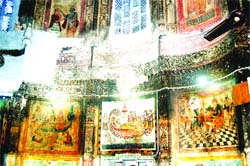
Frescos, wall paintings in temples disappearing

A number of old temples containing beautiful frescos and wall paintings are fast disappearing thanks to indifferent approach of its caretakers and absence of government policy to preserve art. The city is replete with temples containing frescos and wall paintings with subjects taken from Hindu mythology.

Located at Nawa Kot, Radha-Krishan temple has beautiful frescos painted on the upper portion inside the sanctum sanctorum. However, in an utter ignorance towards heritage, bottom portion of the walls have been covered with tiles. A glance over the beautiful paintings on the upper portion revealed that careless preservation has devoid the posterity of the heritage.

According to Ravi Kumar, owner of a shop running from the temple premises, the temple was about two-century old. He said regularly a priest came to conduct prayers. Private management of the temple had conducted its repair with its limited resources. The publicity material written on the outer wall of the structure is a big eyesore.

The Amritsar chapter of the Indian National Trust for Art and Culture (INTACH) had already documented about 300 buildings in the walled city, most of which are facing “slow death” due to indifferent attitude of the authorities. Experts do not hold back their apprehensions that many of these buildings would disappear if the state government failed to amend the law to preserve heritage sites.

Nobody cared to preserve frescoes of Teja Singh Thakur Dwara built by a distant relative of Maharaja Ranjit Singh. Located in the narrow lanes of the city, the temple was dedicated to Rasha-Krishan. Sky scrapping top of sanctum sanctorum was a landmark and its construction was typical of medieval temple architecture.

Building of Veerbhan Da Shivala, dedicated to Lord Shiva, dates back to the period of Maharaja Ranjit Singh Singh. Its frescoes evoke devotion among people.

Experts are of the view that haphazard and unplanned development of the city over a period of time posed a serious threat to heritage. With migratory trends from rural areas to the city, the city is growing to the status of the most vibrant city and metropolitan centre. However, in the frenzy of competing with modern cities its planners forgot to secure its enormous wealth in the shape of heritage.

Rapidly changing city profile, misuse of built space, uncontrolled traffic and unauthorised building activities had damaged the very sanctity of the heritage areas.

Source: www.punjabheritage.org